
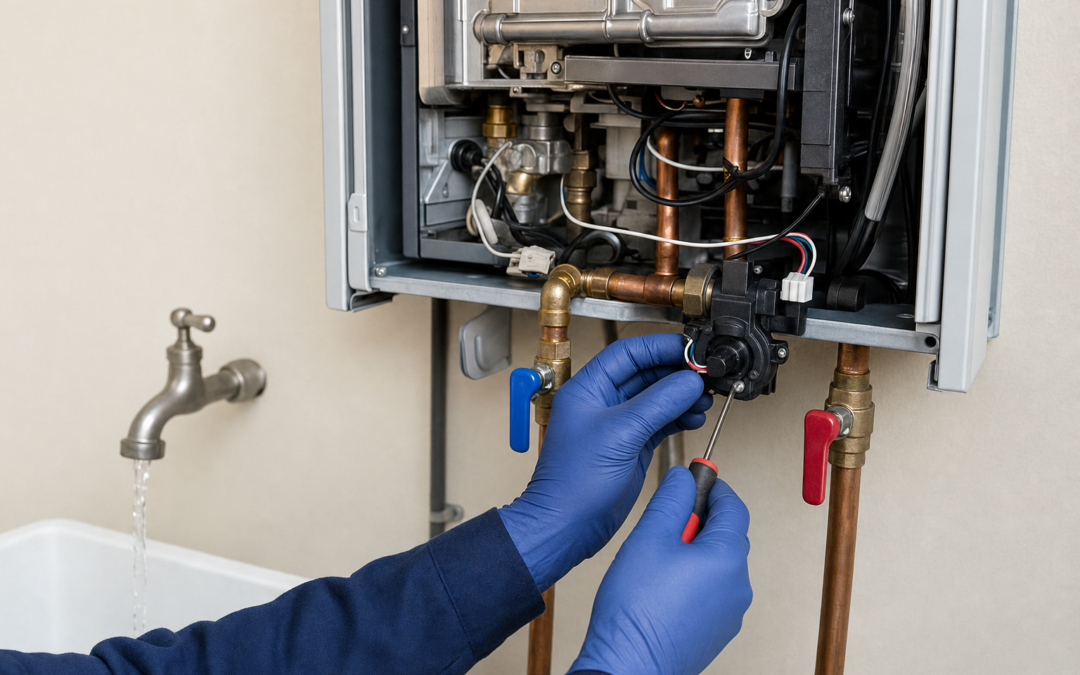
A tankless water heater can go cold at low flow when too little water moves through the unit to keep its heating cycle activated. Every tankless model needs to detect a minimum amount of flow before the burner or heating elements turn on, and many units also need enough continuing flow to stay on. A lightly opened faucet or restrictive fixture can fall below that threshold even though the heater works normally with a stronger draw.
The same symptom can appear when an aerator, inlet screen, valve, or pipe restriction reduces flow, or when the heater’s flow sensor is dirty, sticking, or failing. The pattern does not automatically mean the unit is undersized or needs replacement. A measured diagnostic can separate a normal activation limit from a fixture restriction or a service problem.
Why Tankless Heaters Need a Minimum Water Flow
A storage water heater keeps a tank of hot water ready. A tankless unit starts heating after it senses water moving through the appliance. Its flow sensor reports that demand to the control system, which then starts the heating sequence and regulates output as water passes through.
The minimum activation rate is not the same for every heater. It can vary by model, condition, incoming-water temperature, and how the controls are designed. Some units also have a sustaining threshold that differs from the initial start point. A fixture may trigger the heater when first opened, then let the unit shut off after the handle is turned down.
That is why a bathroom faucet can feel hot at a moderate stream but turn cool when reduced to a trickle. The fixture is still moving water, but the heater may no longer recognize enough demand to continue heating it.
What Can Reduce Flow Below the Activation Threshold?
Low flow can begin at the fixture, in the home’s water supply, or inside the tankless unit. The location matters because each condition calls for a different correction.
A Restrictive Aerator or Showerhead
Faucet aerators and low-flow showerheads limit water use by design. Mineral debris can make them more restrictive over time. If one faucet causes the problem while other fixtures keep the heater running, that fixture’s flow may be the useful starting point for diagnosis.
The result can be confusing: the faucet seems to have acceptable pressure, yet its actual flow is too low to sustain the heater. Increasing the handle slightly may bring hot water back, but that observation is not a repair. It only shows that the heater responds when more water passes through it.
A Partially Closed Valve or Supply Restriction
A fixture stop valve, service valve, or another supply valve that is not fully open can reduce the amount of water reaching the heater or fixture. Debris in a line can produce a similar restriction. Whole-home pressure problems may also reduce flow at several fixtures, especially when water is being used elsewhere.
Do not force a valve that is stuck, corroded, or leaking. Its position and condition can be checked during service without turning a low-flow complaint into a valve or supply-line leak.
An Inlet Screen or Scale Restriction
Many tankless units have an inlet filter or screen that helps keep debris away from internal components. A restricted screen can reduce flow through the heater. Mineral scale inside water passages can also interfere with performance and heat transfer.
Neither condition can be confirmed from water temperature alone. Opening the unit, removing a screen, or circulating descaling chemicals requires model-specific isolation and handling. A technician should determine whether restriction is actually present before maintenance is used as the answer.
A Dirty or Failing Flow Sensor
The flow sensor is the component that tells the heater water is moving. Depending on the model, it may use a small turbine, magnetic pickup, or another sensing design. Debris, scale, wear, a sticking internal part, a wiring issue, or sensor failure can make the reported flow differ from the water actually moving through the unit.
A sensor problem becomes more plausible when the heater starts inconsistently, fails at more than one low-flow fixture, or behaves differently at similar flow rates. Error history and live diagnostic readings can help, but an error code by itself does not prove which part needs replacement.
How Low-Flow Shutdown Differs From an Undersized Unit
An undersized tankless heater usually struggles when demand is high. Two showers, a dishwasher, and another hot-water fixture operating together may ask the unit to heat more water than it can handle at the desired temperature. The result may be a temperature drop during simultaneous use.
A low-flow activation problem shows the opposite pattern. The heater may work well with a shower or a strongly opened faucet, then stop heating when only a small stream is requested. Replacing the unit with a larger model would not necessarily correct an aerator restriction, inlet blockage, sensor problem, or activation threshold.
A brief cold-water sandwich is also different. That term describes a short burst of cool water between hot-water draws as water already in the piping moves through. Continuous cold water at a low, steady draw points toward a different diagnostic path.
Safe Observations Before Scheduling Service
You can collect useful information without removing the heater cover or changing its controls:
- Note which faucets or showers cause the temperature change.
- Compare a low draw with a moderate draw at the same fixture.
- Check whether hot water returns when only one fixture is used.
- Notice whether the display shows a normal heating indication or an error, without changing settings.
- Record whether the symptom began after fixture work, water shutoff, maintenance, or a change in household water pressure.
- Note any unusual noise, leak, odor, or visible corrosion near the unit.
Avoid repeatedly raising the temperature to compensate. Do not bypass a sensor, force a service valve, open gas or electrical controls, remove an inlet screen, or disassemble the heater. Tankless units combine water, fuel or high-voltage power, combustion or heating controls, and model-specific safety devices.
If the unit leaks, smells like fuel gas, makes an abnormal combustion sound, or shows signs of overheating or electrical trouble, stop using it. Leave the area and contact the gas utility from a safe location if a gas leak may be present.
What a Tankless Diagnostic May Include
A plumber can reproduce the symptom while measuring actual water flow and temperature. The inspection may compare several fixtures, verify available pressure, check valve position, review the heater’s settings and error history, and confirm whether the unit recognizes the draw.
When appropriate for the model, the technician may inspect the inlet filter, flow-sensor operation, internal water path, and evidence of scale. The evaluation may also look for a hot-and-cold plumbing crossover that allows cold water to dilute the hot side, or a fixture cartridge that behaves differently at low flow.
The correction should follow the measured cause. A restricted fixture may need fixture-side service. An inlet obstruction may need cleaning after safe isolation. Scale may call for approved maintenance. A faulty sensor, valve, control, or other component may need repair. If the unit is correctly sensing flow but the requested draw remains below its designed activation range, the discussion may focus on fixture compatibility or manufacturer-approved options rather than replacing an unrelated part.
Professional tankless water heater service can keep the diagnosis tied to the actual flow rate and equipment condition. Broader hot-water symptoms that are not limited to a tankless unit may warrant a water heater evaluation instead.
When to Call for Tankless Water Heater Service
Schedule service when the low-flow cold-water pattern is repeatable, affects several fixtures, appears with an error, or continues after ordinary fixture use has been compared. Service is also appropriate when water pressure has changed, the heater has missed maintenance, or the symptom follows plumbing work and the source is unclear.
A tankless unit that no longer heats at any flow needs a broader diagnosis. A leaking unit, fuel-gas odor, damaged vent, scorched connection, or electrical concern should not be treated as a flow-only inconvenience.
Get the Low-Flow Problem Checked in Cypress
Hot water that disappears only when the stream is reduced gives a technician a valuable clue. It can point toward the heater’s activation threshold, restricted water flow, or a flow-sensing problem, but testing is needed before a part or maintenance step is chosen.
If your tankless water heater goes cold at low flow, contact Champion Plumbing Services. The team can inspect the heater and connected plumbing at your Cypress home, measure what the unit is receiving, and explain the repair or adjustment supported by the findings.