
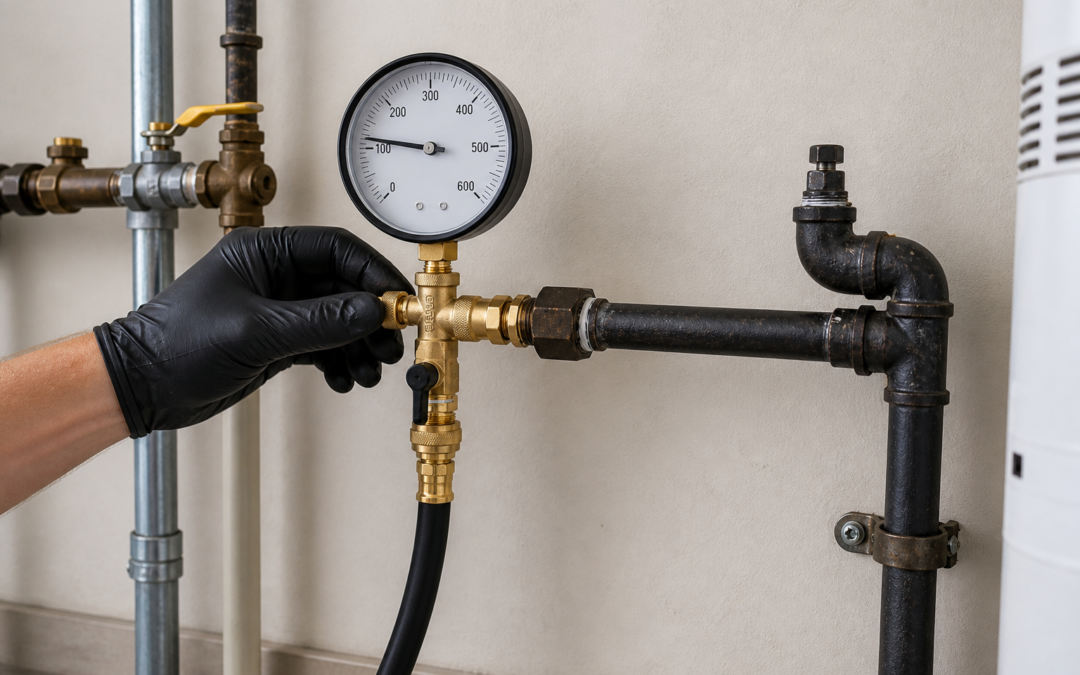
A professional gas-line pressure test shows whether an isolated section of piping holds a controlled test pressure under the conditions of that test. A stable reading supports that no pressure loss was detected in the tested section during the test period. A falling reading shows that pressure is escaping somewhere within the test boundary, but the gauge alone does not reveal the exact leaking fitting, joint, valve, or pipe segment.
The test is not a safe do-it-yourself project. Gas piping must be isolated correctly, appliances must be protected from test pressure, and the result must be interpreted in the context of the test setup. Homeowners should never add pressure, operate unfamiliar gas valves, disconnect an appliance, use a flame to search for a leak, or try to recreate a professional test.
If you smell gas, hear hissing, receive a gas alarm, or feel dizzy or ill, leave the building without operating switches, phones, flames, vehicles, or gas controls inside. From a safe location, contact the gas utility or emergency services and follow their directions. Do not wait inside for a routine plumbing appointment.
What a Stable Pressure Reading Means
Before a test begins, a technician establishes which piping is included and isolates equipment that should not receive the test pressure. The test assembly then allows the technician to observe whether pressure remains stable for the required conditions and test period.
When the reading remains stable, the result supports one narrow conclusion: the isolated section did not show a measurable pressure loss during that test. It does not prove that every gas appliance, connector, control, or pipe elsewhere in the property is leak-free. An appliance connection that was outside the test boundary, an intermittent condition, or a component tested under different operating conditions may need separate evaluation.
The technician’s record of the test boundary matters as much as the gauge reading. Ask which section was isolated, which appliances or branches were excluded, and whether any utility or permitting requirement affects the next step. That context prevents a limited pass result from being misunderstood as an unlimited guarantee.
What a Pressure Drop Means
A pressure drop means the isolated test section did not hold pressure under the test conditions. That is evidence of leakage somewhere inside the defined boundary. It is not, by itself, a map to the defect.
The loss might be associated with a threaded joint, fitting, valve, appliance branch, damaged pipe, or another accessible or concealed part of the tested system. The gauge cannot distinguish among those possibilities. The size or speed of the drop may help a technician plan further diagnosis, but it should not be used to guess at a specific repair from a distance.
After a failed test, the technician may divide the system into smaller sections, inspect accessible connections, use approved detection methods, and compare the result with known construction or damage history. The objective is to narrow the leak location without exposing appliances or occupants to unsafe test conditions.
Why Appliances and Sections Are Isolated
Test pressure that is appropriate for gas piping may not be appropriate for an appliance regulator, control valve, connector, or other component. A professional therefore defines the test boundary and protects equipment before introducing controlled pressure.
Isolation also makes the result useful. If the entire property were treated as one undefined system, a failed test would provide little direction. Dividing the piping into known sections can help determine whether the loss is associated with a branch, an appliance connection, an outdoor run, or another part of the distribution system.
Do not turn valves or disconnect equipment in an attempt to help. An unfamiliar valve may affect more than one appliance, and moving a damaged or corroded component can worsen a leak. Tell the technician what equipment is present and leave the setup unchanged unless the gas utility or emergency personnel give different instructions.
A Pressure Test Does Not Replace Active-Leak Safety
A scheduled pressure test is appropriate only after immediate safety conditions have been addressed. Gas odor, hissing, a detector alarm, unexplained illness, or a utility shutoff can indicate a situation that requires occupants to leave first.
While exiting, avoid actions that could create a spark or flame. Do not switch lights on or off, use a match or lighter, start a vehicle in an attached garage, plug in or unplug equipment, or use a phone while still inside. Once everyone is at a safe location, call the gas utility or emergency services and follow their instructions.
Do not reenter or attempt to restore gas service because the odor seems to fade. Ventilation, weather, and airflow can change what you smell without resolving the source. Only the utility or qualified personnel responding to the condition should determine when the property can be approached and what must happen before service is restored.
Useful Observations to Report
Details gathered without touching the gas system can help the technician plan the inspection. From a safe location, report:
- When the odor, alarm, utility notice, or suspected problem first occurred
- Whether the condition seemed associated with one appliance, one room, outdoors, or the entire property
- Whether an appliance recently stopped working, was replaced, or was moved
- Whether remodeling, drilling, digging, foundation work, storm damage, or utility work recently occurred
- Whether the gas utility shut off or tagged the service and what written instructions were left
- Whether another contractor recently worked near gas piping
- Whether the problem is continuous, intermittent, or appeared after a particular event
- Whether anyone experienced headache, dizziness, nausea, confusion, or another sudden symptom
Do not stay in or return to a building with suspected active gas merely to collect these details. Safety observations are helpful only when they can be made without exposure.
What Happens After a Failed Test
A failed pressure test begins the location process; it does not automatically mean all gas piping must be replaced. The repair scope depends on where the loss is found, the material and condition of the piping, access, the number of affected sections, and any requirements that apply before gas service can be restored.
An accessible leaking joint may have a different repair path from a damaged concealed run or a system with multiple failed sections. If corrosion, physical damage, unsupported piping, or incompatible components are found, the technician may need to assess more than the point where pressure loss was first detected.
The proposed work should identify the affected section, the repair or replacement boundary, any access needed, and what verification follows. If another trade, the gas utility, or an inspection is involved, that coordination should be clear before work begins.
Why a Post-Repair Test Matters
Finding and repairing one defect does not establish that the entire intended section is sound. The repaired system must be tested again within the required scope. A stable post-repair result confirms that the isolated piping held during that new test; it also creates a clearer handoff for any required inspection or utility restoration process.
If the retest still shows a pressure loss, the correct response is additional diagnosis—not repeated tightening, random part replacement, or restoring gas and hoping the condition has ended. Each result should guide a narrower, evidence-based next step.
Keep any written test result, repair description, inspection record, or utility notice with the property’s service records. Those documents can clarify which piping was tested and what work was completed if another appliance or branch needs service later.
What Not to Do Before Service
Gas-line diagnosis has a firm safety boundary. Do not:
- Connect a compressor, air tank, pump, or gauge to gas piping
- Operate a meter valve, appliance shutoff, regulator, or test port unless the utility or emergency personnel direct you
- Loosen a fitting or disconnect an appliance to see whether pressure changes
- Use a match, lighter, candle, torch, or any flame to search for a leak
- Apply random liquids or household products to gas fittings
- Relight an appliance or restore gas service after a shutoff
- Cover an odor with fans, sprays, or open flames
- Assume that no odor means no leak
These actions can create ignition, damage components, expose appliances to improper pressure, or make the eventual test harder to interpret. Preserve the condition as found and give the technician the history instead.
What to Expect From a Professional Evaluation
The visit should begin with the reported symptoms, utility status, appliance inventory, recent work, and the portion of the system that needs evaluation. The technician can then determine whether conditions are safe for testing and establish an appropriate test boundary.
Depending on the findings, the work may include inspecting accessible piping, isolating branches, protecting appliance controls, connecting calibrated test equipment, monitoring the reading, and narrowing any pressure loss with approved detection methods. The result should explain what was tested, what passed or failed, what defect was found, and what must happen before the system returns to service.
Champion Plumbing Services provides gas line repair in Cypress. When no active-release emergency is present, use the service request options there to describe the utility status, suspected location, affected appliances, and recent work. If gas is actively suspected, leave first and contact the gas utility or emergency services from a safe location.
Frequently Asked Questions
Does a pressure test show exactly where a gas leak is?
No. A pressure drop confirms a loss somewhere within the isolated test boundary. The technician must use additional sectioning, inspection, and approved detection methods to locate the exact fitting, joint, valve, or pipe segment.
Does a stable test mean every appliance is safe?
Not necessarily. Appliances and their controls may be isolated from the piping test. A stable result applies to the specific section and conditions documented by the technician. Appliances, connectors, combustion, venting, and controls may require separate checks.
Can a homeowner perform a gas pressure test?
No. Incorrect pressure, isolation, connections, or valve operation can damage equipment and create a serious hazard. The test requires appropriate instruments, a defined boundary, and professional interpretation.
What if the gas utility already shut off service?
Leave the utility’s shutoff or tag undisturbed. Share its written instructions with the plumber. Repair, testing, inspection, and restoration requirements can differ, and only the authorized party should restore service.
Should I wait for a plumber if I smell gas now?
No. Leave the building without operating switches, flames, phones, vehicles, or gas controls inside. Call the gas utility or emergency services from a safe location and follow their instructions. A routine repair visit comes after the immediate hazard has been addressed.
Schedule Gas-Line Diagnosis in Cypress
A pressure test answers a specific question: did the isolated piping hold under the documented test conditions? A stable reading supports that tested section; a falling reading confirms a loss but not its location. Professional isolation, diagnosis, repair, and retesting turn that result into a safe repair decision.
For a suspected gas-line problem without an active-release emergency, request [Champion Plumbing Services gas-line service](https://plumbingchamp.com/gas-line-repair/). If there is an odor, hissing, an alarm, or sudden illness, leave first and call the gas utility or emergency services from a safe location.