
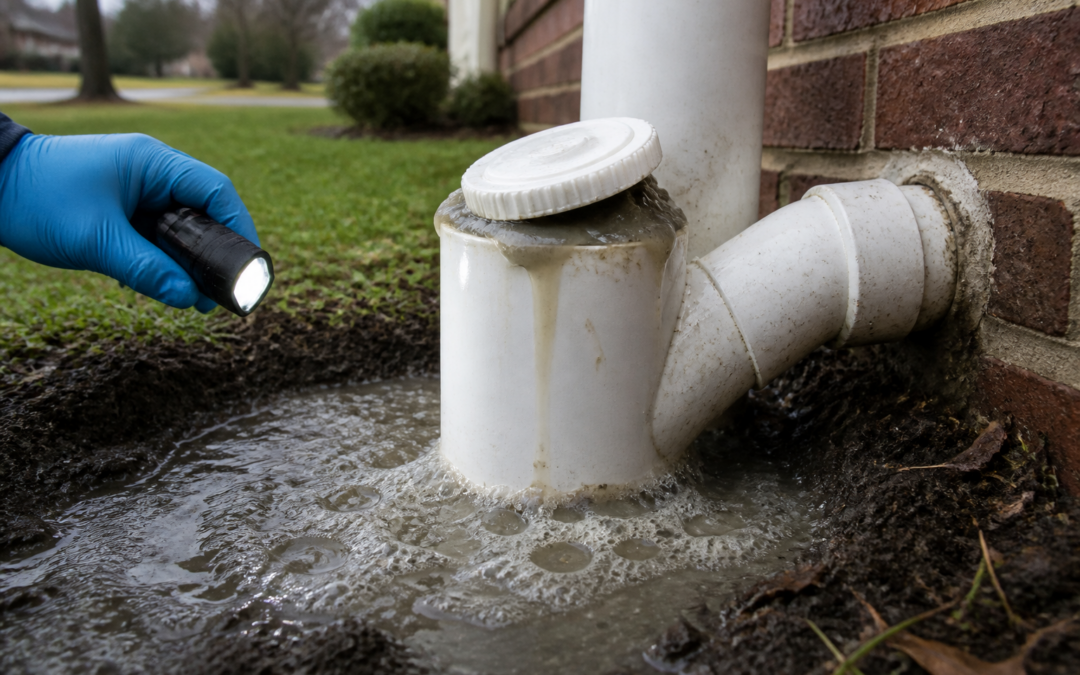
Sewage coming out of an outdoor cleanout usually means wastewater cannot continue through part of the sewer path and is escaping at an available low opening. A restriction downstream of the cleanout is one possibility, but roots, grease or debris, a shifted or damaged pipe, heavy flow, or a problem beyond the property connection can create similar symptoms. The overflow location alone does not identify the exact cause.
Stop using water inside the home as soon as you notice the overflow. Do not flush toilets, run faucets, start laundry, use the dishwasher, or test other fixtures. Keep children and pets away from the wet area, avoid skin contact, and stay clear of any standing water near outdoor electrical equipment. Do not remove, tighten, or handle the cleanout cap while wastewater may be pressing against it.
An Outdoor Cleanout Is an Access Point, Not a Drain Outlet
A sewer cleanout is a capped access fitting connected to a building drain or sewer line. A plumber can use it to inspect, clear, or test the line without opening finished walls or removing a toilet. Cleanouts may be near an exterior wall, in a yard, beside a driveway, or inside a protective box at ground level.
Wastewater should pass through the connected pipe below the cap. It should not normally rise through the fitting or collect around it. If the cap is loose, cracked, missing, or displaced, backed-up water may escape there before it appears at a lower indoor fixture. A securely seated cap may instead leave the first visible backup inside a shower, tub, floor drain, or toilet.
The cleanout can reveal where pressure or backed-up flow is reaching, but it is not a safe pressure-relief device. Opening a cap on a loaded line can release sewage suddenly. Leave the fitting as you found it and tell the plumber whether the cap appears intact, tilted, cracked, or already missing.
Stop Adding Water and Isolate the Area
Every gallon sent into a restricted sewer path can add to the outdoor spill or push wastewater toward the house. Ask everyone in the home to pause water use until the line is evaluated. If the overflow is near a neighbor’s property, sidewalk, storm drain, play area, or public walkway, keep people away and mention that location when requesting service.
Avoid sweeping, hosing, or pressure-washing the wastewater into the street or a storm drain. Do not spread contaminated soil across the yard with shoes, lawn equipment, or pet traffic. If you must move through the area to reach safety, avoid direct contact and clean contaminated footwear separately.
Sewage near a receptacle, extension cord, landscape-light connection, air-conditioning disconnect, or other electrical equipment adds another hazard. Do not step into wet ground to unplug or operate anything. Keep your distance and tell the service provider what equipment is nearby.
The Timing of the Overflow Helps Locate the Problem
Notice what was happening just before water appeared, but do not recreate the condition. Useful details include:
- Whether the overflow began during a toilet flush, shower, laundry drain, dishwasher cycle, or several fixtures running together.
- Whether one bathroom or every part of the house had been draining slowly.
- Whether a toilet bubbled, a tub rose, or another fixture backed up first.
- Whether the cleanout overflows only during household water use or continues when all fixtures are off.
- Whether the event followed heavy rain or has happened in dry weather too.
- How quickly the water level falls after household use stops.
- Whether paper, food residue, grease, soil, or only cloudy water is visible from a distance.
- Whether the cap moved, cracked, or had already been loose before the overflow.
An overflow that starts when a large household volume drains may indicate that the line can pass a small flow but not a full one. Wastewater that continues surfacing when no one is using water deserves prompt attention because flow may be entering from another connected source or the backed-up system may still be releasing retained water.
Rainfall can be relevant in Cypress, but timing after rain does not prove that stormwater entered the sewer or that the public main is responsible. Saturated soil, an existing pipe defect, an improper connection, or unrelated heavy household use may coincide with the same event. Inspection is needed before assigning a cause.
A Downstream Restriction Is One Common Possibility
If the cleanout is upstream of a restriction, wastewater may reach the fitting and rise because the route beyond it is narrowed or blocked. The material could include accumulated grease, wipes or other unsuitable products, debris, or roots entering through a vulnerable joint. The line may also have poor slope, a separated connection, a low section that retains material, or physical damage that catches solids.
Do not assume the visible material identifies what is blocking the pipe. Paper at the cleanout may simply be part of normal wastewater held behind another obstruction. Roots visible near the yard surface do not prove that roots entered the line. Likewise, an older pipe is not automatically broken.
Professional sewer line repair and replacement evaluation separates retained material in an otherwise usable pipe from a structural condition that cleaning cannot correct.
House-Side and Public-Side Problems Can Look Similar
The location of the cleanout, direction of flow, property connection, and affected neighbors all matter. If only one home is affected and the restriction is between the building and its connection, the cause may be on the private sewer path. If nearby properties experience backups at the same time or flow continues from farther downstream, a public-side condition may need to be considered.
Those patterns are clues, not a final boundary decision. More than one cleanout may be present, and the fitting closest to the house does not always provide access to every section. A plumber can identify the pipe direction, compare water levels, and determine whether the accessible line can be cleared and tested. When evidence points beyond the serviceable property connection, the appropriate utility or authority can be contacted with specific findings.
Do Not Open the Cap or Try to Force the Line Clear
A tilted cap can make the repair look as simple as tightening it. If wastewater is behind the fitting, tightening the cap may redirect the backup into the home. Removing it may release a larger volume toward the person standing over it.
Avoid these actions:
- Do not touch, remove, tighten, or replace the cap while the line may be loaded.
- Do not flush a toilet or run a hose to see whether the overflow returns.
- Do not pour drain cleaner, acid, bleach, enzymes, or another product into the cleanout or an indoor fixture.
- Do not mix cleaners or add a second product after one has already been used.
- Do not insert a rented cable, garden hose, pressure nozzle, rod, or improvised tool.
- Do not dig around the pipe or strike the fitting to loosen the cap.
- Do not use a wet vacuum or pump to move sewage into the street, yard, or storm drainage.
Tell the plumber about any product or tool already placed in the system. That information affects how the line can be approached safely.
What a Professional Sewer Evaluation Checks
The first goal is to control exposure and understand the flow path. A plumber can inspect the cleanout condition, identify the likely direction of the sewer, ask which fixtures were active, and check whether indoor drains show the same backup pattern. Access should be opened in a controlled way with protective equipment and a plan for retained wastewater.
Depending on the findings, service may include:
- Checking the accessible cleanout, cap, riser, and surrounding soil for damage or displacement.
- Determining whether the line is holding water and which direction is affected.
- Using an appropriate clearing method for the pipe size, material, access, and suspected obstruction.
- Testing controlled fixture flow after the line is open.
- Performing a sewer camera inspection after standing water and loose debris no longer block a useful view.
- Documenting roots, cracks, offsets, bellies, corrosion, intrusion, or another physical condition if visible.
- Comparing cleaning, monitoring, spot repair, or larger repair options based on what the pipe actually shows.
A camera is valuable when conditions allow, but it cannot see clearly through opaque backed-up water or heavy debris. Restoring controlled flow may need to come first. The inspection should then look for the reason material collected rather than treating an open line as proof that the underlying problem is gone.
Cleaning and Repair Address Different Conditions
drain cleaning can remove certain obstructions and restore flow through a structurally usable line. It cannot correct a collapsed section, separated joint, severe offset, failed fitting, or pipe segment that no longer maintains a workable path.
Repair becomes part of the discussion when inspection finds physical damage, repeated root entry through a vulnerable joint, a displaced section, or another condition likely to keep catching material. The scope should follow the location and extent of the defect. An outdoor cleanout itself may also need repair if the riser, adapter, or cap is cracked, but fixing the access fitting alone will not clear a downstream restriction.
After service, the line should accept a controlled flow without wastewater rising at the cleanout or backing up indoors. The cap and riser should be checked after the test, and any remaining limitation should be explained before normal household use resumes.
Address the Surface Contamination After Flow Stops
Stopping the sewer overflow comes before cosmetic yard cleanup. Once the plumbing condition is controlled, the affected surface can be assessed based on how much wastewater escaped, where it traveled, and what materials it contacted. Porous items, mulch, soil, play equipment, or a public surface may need a different response than a small spill confined to a service area.
Keep the area isolated until appropriate cleanup is complete. Do not assume that rain or a garden hose makes the surface sanitary. If wastewater entered the home, reached an HVAC intake, crossed a public path, or spread beyond an area you can safely isolate, describe that extent when arranging professional cleanup help.
Request Prompt Sewer Help in Cypress
If sewage is coming out of an outdoor cleanout at your Cypress property, stop household water use and keep people and pets away from the spill. Contact Champion Plumbing Services for a controlled sewer evaluation. The team can inspect the cleanout and flow path, determine whether clearing or camera inspection is appropriate, and explain whether the evidence points to retained material, pipe damage, or a condition beyond the accessible property line.