
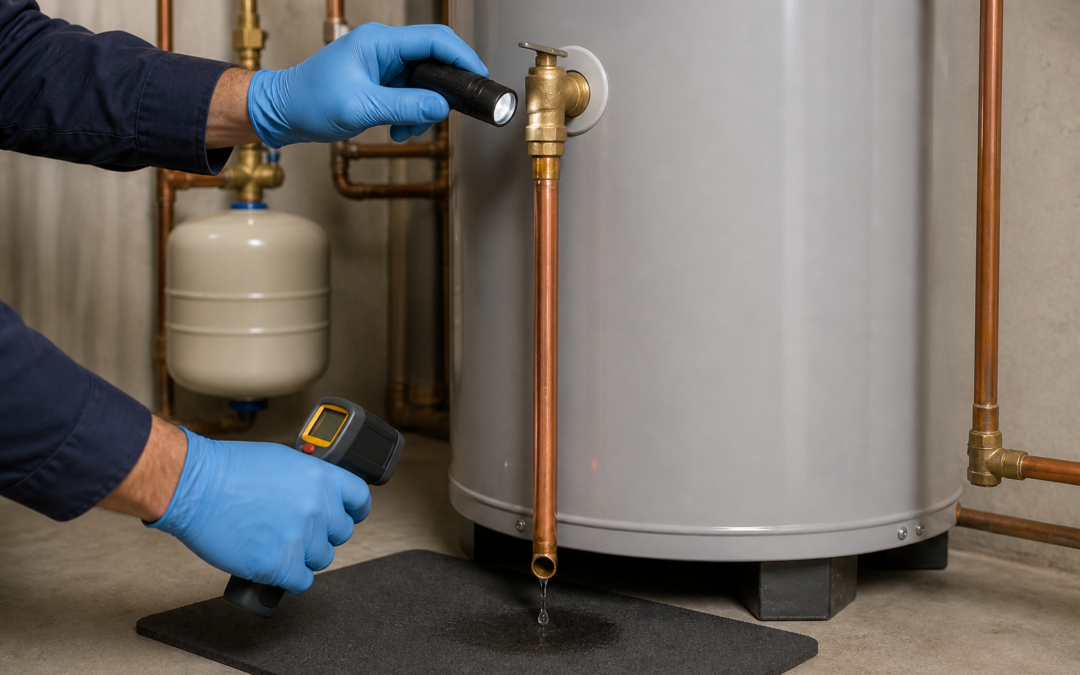
Persistent water from a tank water heater’s temperature-and-pressure relief valve means the valve is either responding to a pressure or temperature condition or is no longer sealing fully. Common possibilities include excess supply pressure, thermal expansion as the tank heats, excessive water temperature, debris on the valve seat, a worn valve, or an installation problem. The drip alone cannot identify which condition is present.
The relief valve is a safety device. Never cap, plug, clamp, kink, or force its discharge pipe shut. Do not operate the test lever to troubleshoot an active leak. Water from the pipe may be hot enough to cause injury, so observe it from a safe distance and arrange diagnosis.
Confirm Where the Water Is Coming From
A temperature-and-pressure relief valve, often shortened to T&P valve, is usually mounted near the top or on the upper side of a tank water heater. A dedicated pipe carries any release downward or to another approved discharge point. If water appears at the open end of that pipe, the relief valve is discharging or failing to seal.
Water in a drain pan does not prove that the relief valve is the source. A supply connector, shutoff connection, tank fitting, drain valve, or tank seam can leak and send water to the same low point. Condensation or water from nearby equipment can also collect around the heater.
From a dry, safe position, note where the first visible drop forms. Do not remove insulation, disconnect piping, reach behind the tank, or touch the discharge pipe. A plumber can trace the source safely and keep a separate leak from being mistaken for a relief-valve problem.
A Brief Test Release Is Different From Ongoing Leakage
If a technician deliberately operated the T&P test lever during recent service, a brief release while the lever was open is expected. Water should stop after the test is complete and the valve reseats. A continuing drip, a leak that returns during heating cycles, or flow that begins without a known test needs attention.
Sediment or mineral particles can lodge on the valve seat after a test or pressure event. An older seal or spring may also fail to close fully. Do not keep moving the lever in an attempt to wash debris away. Repeated operation can increase leakage, and it does not determine whether the valve opened for a real pressure or temperature condition.
Excess Supply Pressure Can Open the Valve
Water entering the home at excessive pressure can place added force on the heater, fixtures, connectors, and relief valve. The valve may release water if pressure reaches its opening threshold. Even when the valve does not open fully, sustained high pressure can contribute to wear and intermittent dripping.
Faucet flow that suddenly seems stronger, banging when valves close, or recent work on a pressure regulator can be useful observations, but none confirms high pressure. A plumber needs to measure pressure at an appropriate test point and watch how it behaves under different conditions. Do not install a gauge, adjust a regulator, or close unfamiliar valves as a leak experiment.
Thermal Expansion Can Raise Pressure During Heating
Water expands as it heats. In some plumbing systems, a check valve, backflow device, or pressure-reducing valve limits the expanded water’s path back toward the supply. The added volume can then raise pressure inside the home’s piping while the water heater reheats.
This pattern may produce dripping that begins after a large hot-water use, continues while the tank reheats, and slows after pressure changes elsewhere in the system. Timing is helpful, but it is not proof. Supply pressure, temperature controls, and valve condition can create overlapping symptoms.
Some homes have an expansion tank or another means of managing the pressure change. Its presence does not establish that it is correctly sized, charged, connected, or working. Do not tap it, press its air valve, or attempt to add air. A plumber can test the system pressure through a heating cycle and evaluate the expansion-control equipment without guessing from appearance.
Excessive Water Temperature Needs Prompt Diagnosis
The T&P valve is also designed to respond when tank temperature becomes unsafe. A thermostat, gas control, heating element, sensor, wiring condition, or another control problem may allow excessive heating, depending on the type of heater.
Water that becomes much hotter than usual at more than one fixture is an important warning. Steam at a faucet, forceful hot discharge, rumbling with extreme heat, or a tank that looks distorted calls for prompt attention. Keep away from the discharge pipe and leave the heater controls alone. Do not lower and raise settings repeatedly, open an access compartment, relight equipment, or reset an electrical control to see whether the symptom returns.
Debris or a Worn Valve Can Prevent a Tight Seal
A relief valve can begin dripping because its internal sealing surface is worn, corroded, or obstructed by debris. That becomes more likely when leakage starts immediately after a deliberate test or after the valve has opened during a pressure event. It is still important to check why the valve discharged before treating the component itself as the only problem.
Replacing a valve without measuring pressure and temperature can leave the new valve exposed to the same condition. The reverse is also true: correcting a pressure problem may not stop a valve whose seat has already been damaged. Diagnosis should separate the triggering condition from the valve’s ability to reseal.
Installation Conditions Can Contribute
The valve must be appropriate for the specific water heater, and its discharge path must allow a safe, unobstructed release. A mismatched valve, a restricted outlet, improper pipe material or routing, a poor connection, or an incorrectly configured expansion-control system can affect operation or make leakage more hazardous.
Never correct a drip by threading a cap onto the pipe, adding a shutoff, pinching the tube, inserting a plug, or redirecting the pipe into a closed container. Blocking the outlet removes the safe release path while pressure or temperature may still be rising. A plumber can compare the valve, discharge piping, and visible installation with the heater manufacturer’s requirements and the requirements applicable to the home.
Record Safe Observations Before Service
Useful details can focus the inspection without exposing anyone to hot water, gas, or electricity:
- Whether water is dripping, running in a thin stream, or flowing continuously
- Whether it begins during reheating, after a large hot-water draw, overnight, or at no clear time
- Whether fixture water has become noticeably hotter than usual
- Whether faucet pressure recently changed or pipes began banging when valves close
- Whether the valve was deliberately tested or the heater, regulator, backflow equipment, or plumbing was recently serviced
- Whether an expansion tank is visible, without touching, tapping, or testing it
- Whether water is limited to the discharge termination or is spreading from another part of the heater
- Whether the unit’s model label and approximate age can be read from a dry, accessible position
A photo or short video taken from a safe distance can capture the flow pattern and timing. Do not place a container under hot discharge, handle the pipe, move stored items through the wet area, or stand in water to get a closer image.
Leave the Heater Alone When the Discharge Is Hot or Forceful
A slow intermittent drip and a forceful hot discharge are not the same risk level. Request prompt help and keep away from the heater when you see steam, very hot water, continuous forceful flow, a rapidly filling pan, spreading water, tank distortion, a burning odor, smoke, or moisture near electrical or gas equipment.
Do not approach the heater to operate controls or valves when doing so requires crossing water, reaching near steam, or touching wet equipment. Keep children and pets out of the area. If there is fire, smoke, active sparking, or another immediate life-safety hazard, call emergency services from a safe location.
Even a small recurring drip deserves diagnosis because the cause may continue between visible releases. Do not rely on running more hot water, cycling the heater, or opening fixtures as a test. Tell the service provider exactly what is happening so the urgency can be assessed from the current conditions.
What a Plumber May Check
A focused evaluation starts by confirming the leak source and identifying the exact valve and discharge route. The plumber may measure incoming pressure, observe pressure changes while the tank heats, check delivered water temperature, and assess whether expansion control is present and functioning. The valve’s rating, age, condition, and connection can then be compared with the heater.
The inspection may also include the thermostat or gas control, heating components, accessible supply connections, tank condition, and discharge-pipe material and routing. Findings determine whether the solution involves correcting supply pressure, restoring expansion control, repairing a temperature-control problem, replacing a damaged valve, correcting an installation condition, or addressing more than one issue.
Champion Plumbing Services provides water heater repair in Cypress for tank and tankless equipment. Homeowners comparing the affected equipment and service scope can also review tank water heater service. The repair recommendation should follow pressure, temperature, valve, and tank findings rather than the drip alone.
Frequently Asked Questions
Can I cap the relief-valve pipe until a plumber arrives?
No. The pipe is the safety valve’s discharge path and must remain open. A cap, plug, clamp, kink, or shutoff can trap dangerous pressure or temperature in the tank. Keep away from the discharge and request service instead of restricting it.
Does dripping always mean the relief valve is bad?
No. A valve can leak because it is worn or cannot reseat, but it may also be opening in response to excess supply pressure, thermal expansion, or excessive temperature. Installation conditions can contribute as well. Pressure, temperature, and component checks are needed before naming the cause.
Should I lift the test lever to clear debris?
Do not use the lever as a troubleshooting step on an actively leaking valve. The discharge may be dangerously hot, the valve may release more water, and debris or a worn seal may prevent it from closing. Tell the plumber whether anyone operated the lever before the leak began.
Is a leaking T&P valve an emergency?
A small drip without heat, steam, or spreading water still needs timely diagnosis. Steam, unusually hot water, forceful continuous discharge, rapid flooding, tank distortion, smoke, burning odor, or water near gas or electrical equipment requires a faster response and a safe distance from the heater.
Does the entire water heater need to be replaced?
Not necessarily. A pressure condition, expansion-control problem, temperature-control fault, damaged valve, installation issue, or tank failure can require different work. The heater’s condition, age, leak source, and test results should guide the repair-or-replacement decision.
Request a Focused Water-Heater Inspection in Cypress
Recurring water from the relief-valve discharge pipe should not be blocked or ignored. Keep the outlet open, avoid contact with the water, record the timing and flow from a safe distance, and leave the heater alone when heat, steam, forceful discharge, or spreading water creates an unsafe approach. A focused inspection can identify whether pressure, expansion, temperature, valve condition, installation, or the tank itself needs attention.