
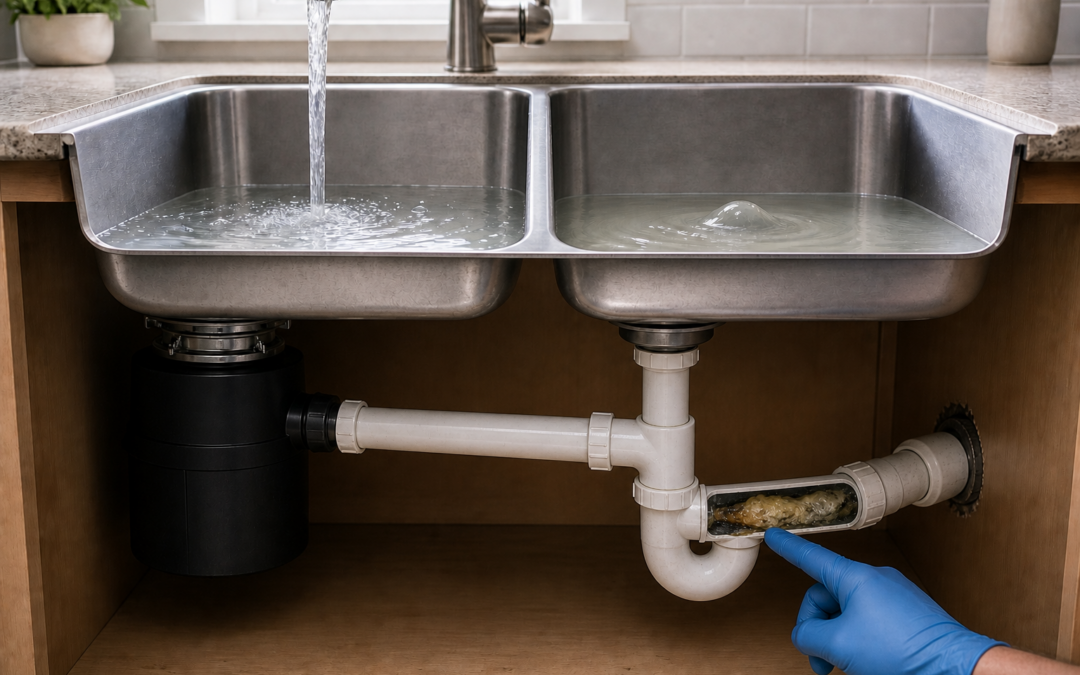
Water backs up into the other side of a double kitchen sink when the two bowls share a drain connection and water cannot move freely through the pipe after that connection. Instead of continuing toward the wall drain, some of the water follows the available path upward through the unused bowl. Grease, food residue, soap buildup, or another partial blockage in the shared trap or branch drain is a common reason, but the exact location needs to be checked before deciding how to clear it.
Stop running the faucet, dishwasher, and garbage disposal until the water settles. Do not put a hand into the disposal, operate it beneath backed-up water, or pour a chemical cleaner into the sink. If a cleaner has already been used, tell the plumber what product entered the drain so the line can be handled safely.
Both Sink Bowls Usually Share One Drain Path
A double-basin sink has a drain opening and tailpiece beneath each bowl. Those two branches join under the sink through a waste arm or tee before wastewater passes through one P-trap and into the branch drain in the wall. A garbage disposal may replace the tailpiece beneath one bowl, but its discharge still joins the same downstream path.
When that shared path is open, water from either bowl moves through the connection, trap, and wall pipe without appearing in the other basin. When a restriction sits after the bowls join, incoming water presses against the narrowed passage. The unused bowl’s drain is then the closest open relief path. Water can rise there before the shared line accepts the full flow.
That pattern is useful evidence. It usually places the trouble beyond the individual drain opening where both bowls can be affected. It does not, by itself, show whether the restriction is inside the connecting arm, P-trap, wall branch, or farther downstream.
The Timing of the Backup Helps Narrow the Problem
Pay attention to what is running when water appears in the opposite bowl. The sequence can help a plumber focus the inspection without guessing.
- If normal faucet flow in either bowl quickly raises water in the other, the shared drain may be substantially restricted.
- If the opposite bowl rises only when a full sink is released, the line may pass a small flow but struggle with a larger volume.
- If the problem appears when the garbage disposal runs, the disposal may be pushing water toward a restriction after its discharge connection.
- If water rises during the dishwasher’s drain cycle, the appliance discharge may be adding water faster than the restricted kitchen branch can carry it.
- If both bowls remain slow after the backup drains away, buildup may be occupying a significant part of the common flow path.
These observations do not prove what material is in the pipe. Grease and food residue are frequent kitchen-drain contributors, but a displaced fitting, damaged pipe, poor slope, or an obstruction farther along the branch can produce a similar result.
Why the Garbage Disposal Can Make the Backup More Obvious
A garbage disposal does not pump wastewater through the home’s drain system like a separate sewage pump. Its spinning plate and impellers break up suitable food scraps and move water out of the disposal chamber. The shared drain still depends on gravity and an open pipe.
When the downstream passage is narrowed, running the disposal can agitate backed-up water and send it across the connecting waste arm. The water may surge into the second bowl, then fall again when the disposal stops. That does not necessarily mean the disposal motor is defective. The symptom may be revealing resistance beyond the disposal outlet.
Do not keep switching the disposal on to test whether the water will eventually clear. Backed-up water can hide utensils or debris near the opening, and repeated operation does not remove every type of blockage. If the unit hums, leaks, trips its protection, or stops turning, leave it off and include that detail when requesting kitchen plumbing service.
Dishwasher Water Can Follow the Same Route
Many dishwashers discharge through a hose connected to the disposal or sink drain assembly. During the drain portion of a cycle, the appliance releases a concentrated volume of water into the same kitchen branch used by both bowls.
If that branch is partially blocked, dishwasher water may rise in one or both sink basins. You might hear gurgling, see cloudy water at the drain opening, or notice residue left behind after the water recedes. A dishwasher backup can also involve its hose, high loop, air gap where installed, or connection point, so the route should be inspected rather than assuming every symptom comes from the same part.
Pause dishwasher use until the sink drains normally. Repeated cycles can add more water to a line that is already struggling and may push moisture through a loose under-sink joint.
Safe Steps to Take Right Away
Limit water entering the kitchen drain. If the basins contain standing water, keep children, utensils, food-preparation items, and electrical appliance cords away from the area. Clear stored items from the cabinet floor only if you can do so without reaching near a leaking disposal, wet receptacle, or damaged wiring.
From a dry position, look for moisture at the visible slip joints, disposal outlet, tee, P-trap, and wall connection. A dry paper towel placed on the cabinet floor can make a new drip easier to notice, but do not tighten or disassemble fittings while the sink is full. A joint that is already under pressure may release dirty water into the cabinet when moved.
Avoid these responses:
- Do not mix drain cleaners or follow one chemical with another.
- Do not pour boiling water into a backed-up sink; heat can stress some piping, seals, and disposal components.
- Do not insert a hand or tool into the garbage disposal.
- Do not remove the trap unless you are prepared for all retained water and know the assembly can be restored without leaking.
- Do not force a drain cable through a disposal or unfamiliar fitting.
- Do not repeatedly fill and release both bowls to test the blockage.
If the water has contacted an electrical connection, switch, or appliance cord, stay clear rather than reaching under the sink.
A Local Kitchen Restriction Is Different From a Wider Drain Problem
When only the double kitchen sink is affected, the likely inspection area begins with the shared under-sink assembly and kitchen branch. A local restriction may cause both bowls to drain slowly while nearby bathroom fixtures continue working normally.
The scope changes when other fixtures join the pattern. A toilet that bubbles, a tub that receives water when another fixture drains, several slow drains, or a floor drain that rises can point beyond the kitchen branch. Sewage odor, wastewater returning in a lower fixture, or an outdoor cleanout releasing water also warrants prompt evaluation.
Do not assume a whole-home sewer problem from the double sink alone. Likewise, do not keep treating the kitchen connection if multiple fixtures are now involved. Tell the plumber exactly which drains are affected and in what order the symptoms appeared.
What Professional Drain Cleaning Checks First
A plumber can start by confirming the sink’s configuration and reproducing the symptom with a controlled amount of water. The goal is to locate the restriction before choosing a clearing method.
The inspection may include:
- Both strainers or the disposal outlet and visible tailpieces.
- The connecting waste arm or baffled tee between the bowls.
- The P-trap and the transition into the wall branch.
- Slip joints, seals, and disposal connections for leaks or misalignment.
- The drainage rate from each bowl separately and together.
- The effect of the disposal or dishwasher discharge when those components can be tested safely.
- Signs that the restriction continues beyond the accessible under-sink piping.
The appropriate drain cleaning method depends on where the blockage sits, what the piping is made of, and whether the assembly is sound. Soft buildup near the fixture may call for a different approach than a compacted obstruction deeper in the branch. Inspection evidence should guide the work.
Cleaning and Repair Solve Different Conditions
Clearing retained grease or debris can restore the open path the two basins need. Cleaning cannot correct a cracked fitting, corroded pipe, damaged disposal outlet, poorly arranged connection, or branch line that no longer maintains proper drainage.
A repair may be needed if water leaks from a joint, a baffle inside the tee is damaged, a pipe has shifted, or the connection repeatedly traps debris because of its condition or configuration. The plumber should explain whether the problem is material inside an otherwise sound line or a physical defect that will remain after cleaning.
If a damaged component is found, drain repair can be discussed based on the affected section. Replacing parts without clearing the downstream restriction may leave the backup unchanged, while cleaning a damaged assembly may allow the leak or poor alignment to continue.
How the Sink Should Be Tested After Service
After cleaning or repair, both bowls should be tested under ordinary flow. Water can be released from each basin separately, then from both in a controlled sequence. The technician can check whether the opposite drain stays clear, whether the trap and joints remain dry, and whether flow into the wall branch is steady.
If a disposal or dishwasher connects to the assembly, its discharge route should be checked when safe and relevant. The cabinet should remain accessible long enough to confirm that no slow seep appears after the larger test volume passes.
The result should be more than a temporarily empty sink. The useful endpoint is normal flow through the shared drain, no cross-basin rise, dry visible connections, and a clear explanation of any condition that still needs attention.
Reducing Future Kitchen Drain Buildup
Keep grease, cooking oil, coffee grounds, fibrous scraps, rice, pasta, and other expanding or stringy material out of the drain. Wipe oily cookware before washing it, use sink strainers, and empty collected food into the trash. Run an appropriate stream of water when using a disposal for manufacturer-approved material, then allow water to carry the small particles through the shared branch.
These habits reduce buildup but cannot guarantee that a drain will stay open. Older pipe surfaces, a long branch, poor slope, or an existing restriction can continue catching material. A double-sink backup that returns after cleaning deserves another inspection rather than stronger chemicals or repeated disposal use.
Schedule a Double-Sink Drain Evaluation
If water backs up into the other side of your double kitchen sink in Cypress, stop adding water and contact Champion Plumbing Services. The team can inspect the shared drain assembly, identify whether the restriction is near the sink or farther along the kitchen branch, and recommend cleaning or repair based on the plumbing that is actually affected.